
If a person wants to start their own business or expand an existing one but does not have enough money to do so. Then the person has only two options, i.e. to take a loan from the bank or to divide the finance cost into units and then sell them as shares in the financial market. The company will buy the shares by which the funds will be raised and will help the person with the startup or the expansion of the business.
So for this, it is very important to know about shares and their types.
What is a Share?
A share is a sole unit of ownership in a company. This is an exchangeable value of a company which goes up and down based on different market factors. The capital is divided into shares for raising capital. Shares are aka stocks.
Shares can be divided into two types:
1) Equity Shares
2) Preference Shares.
1. Equity Shares:
Equity shares, also called as ordinary shares, are a form of part or fractional ownership in which the shareholder has to take the business risk to the extreme. Equity shares are held by the company members who have the right to vote. In a company, Equity shares play a very important role in raising long-term capital.
Ownership of a company is represented by the Equity shares, and the capital that is raised by the issue of such shares is called the ownership capital or the owner’s fund. They are the person who created the company.
The Equity shareholders receive the company’s profit in dividend form, which is not fixed because there is a fluctuation in it as per the profit. It means that if there is more profit, then they will receive more dividend and vice versa.
Classifications of Equity Shares:
- Authorized Share Capital
- Issued Share Capital
- Subscribed Share Capital
- Paid Up Capital
Recommended: What are the Key Differences Between Dematerialisation and Rematerialisation
2. Preference Shares:
Preference shares are the shares that give the company holders a fixed dividend, whose payment is more prior than the equity share dividends. Capital raised by the issue of preference shares is known as the preference share capital. The preference shareholders do not have any rights to control the affairs of the firm. In the event of the bankruptcy of the company, the preferred shareholders are paid before the company’s property.
Types of Preference Shares:
- Cumulative Preference Shares
- Non-cumulative Preference Shares
- Redeemable Preference Shares
- Non-Redeemable Preference Shares
- Convertible Shares
- Non-Convertible Shares
- Participating Shares
- Non-Participating Preference Shares
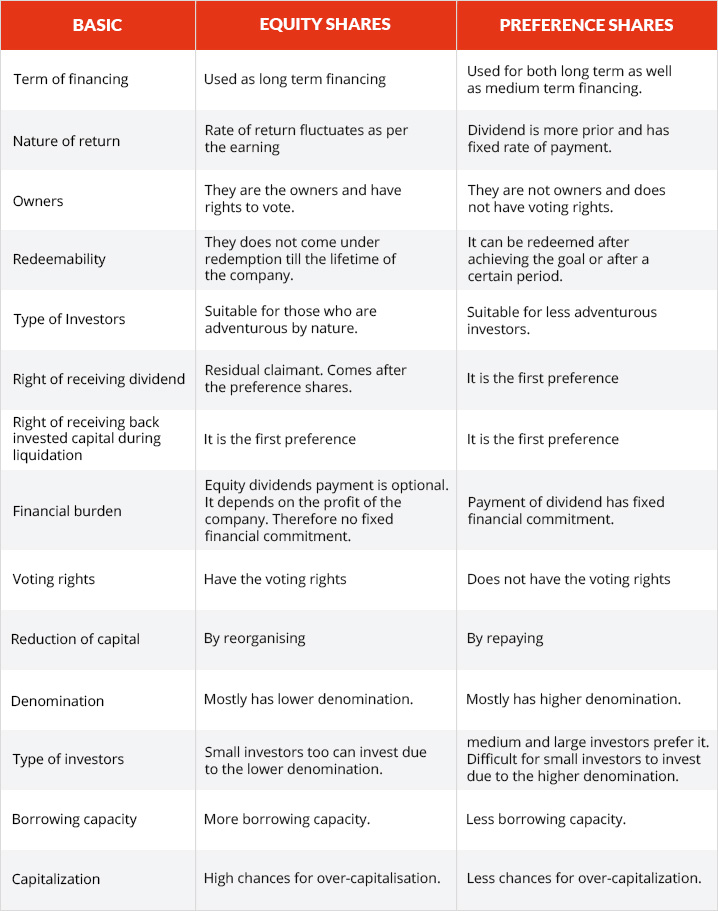
Difference Between the Equity and the Preference Shares:
Given below are the differences between the equity shares and preference shares: